
Puppy Brain Games: 15 Easy Ways to Keep Your Puppy Mentally Busy
Puppies need more than physical exercise.
They also need opportunities to sniff, explore, solve simple problems and learn how to use their brains.
Mental stimulation can be especially useful when your puppy seems bored, restless or constantly looking for something to chew.
The good news is that puppy brain games don’t need to be complicated.
Many can be done using things you already have at home.
Why Mental Stimulation Matters
Mental enrichment gives your puppy something productive to do.
It can help:
- Prevent boredom
- Encourage problem solving
- Build confidence
- Reinforce training
- Redirect unwanted behavior
- Provide an outlet for natural instincts
- Help puppies settle after an activity
Mental games should complement physical activity rather than completely replace it.
1. Find the Treat
Start with an easy version.
Let your puppy see you place a treat nearby.
Say something such as:
Find it!
Encourage your puppy to search for the treat.
As your puppy understands the game, gradually make the hiding places more challenging.
2. Treat Scatter
Scatter a small amount of your puppy’s food or treats across a safe area.
Let your puppy sniff them out.
Grass can work particularly well because it encourages natural searching behavior.
3. Which Hand?
Place a treat in one hand.
Close both hands and let your puppy sniff.
When your puppy indicates the correct hand, open it and give the reward.
Keep the game easy and fun.
4. Muffin Tin Game
Place treats or kibble inside several sections of a muffin tin.
You can make the game more interesting by loosely covering some sections with puppy-safe toys or balls that are too large to swallow.
Let your puppy figure out how to reach the food.
Always supervise.
5. Towel Treat Search
Spread a towel flat and sprinkle some kibble or treats across it.
Loosely fold or roll the towel.
Allow your puppy to sniff and work out how to uncover the food.
Supervise so the towel doesn’t become a chewing project.
6. Cardboard Box Exploration
Place a few treats inside a clean cardboard box.
Add safe lightweight objects your puppy can investigate.
Allow your puppy to explore at their own pace.
Remove the box if your puppy begins eating the cardboard.
7. Cup Game
Place a treat underneath one of two or three lightweight cups.
Let your puppy determine which cup is hiding the reward.
Make it very easy at first.
8. Name Your Toys
Puppies can begin learning that different objects have different names.
Start with one favorite toy.
Say its name whenever you play with it.
Eventually you can ask your puppy to find that particular toy.
9. Hide and Seek
Have someone gently hold your puppy while you hide somewhere nearby.
Call your puppy.
When they find you, reward them with praise, play or a small treat.
This combines enrichment with recall practice.
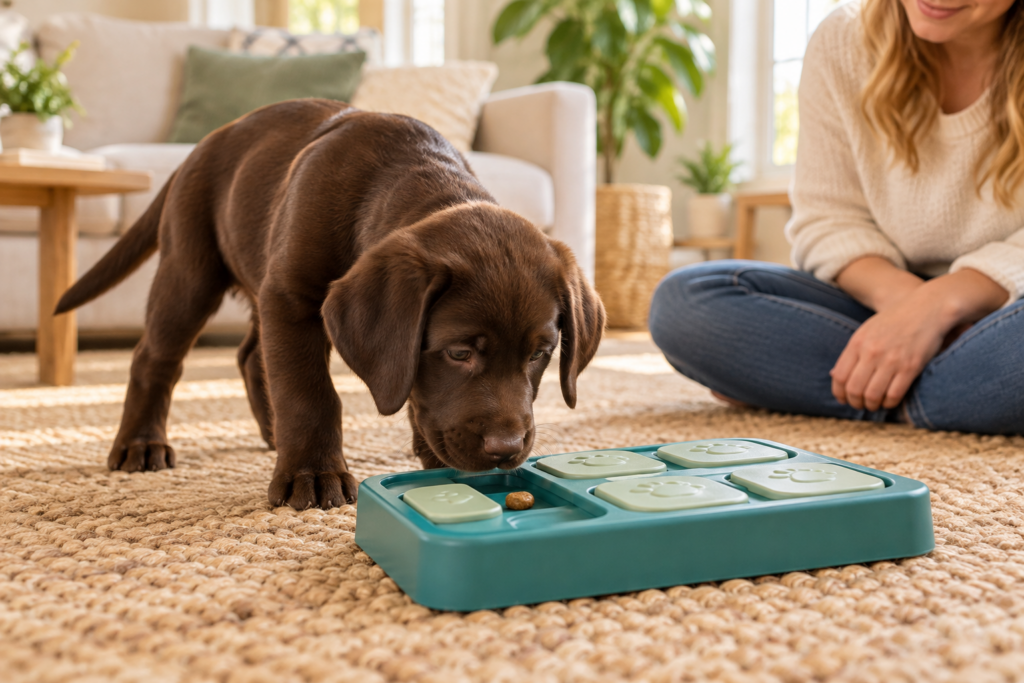
10. Food Puzzle Toys
Puzzle toys make your puppy work a little for their food.
Start with very easy puzzles.
If the puzzle is too difficult, your puppy may become frustrated instead of entertained.
Increase difficulty gradually as your puppy learns how the toy works.
11. Lick Mats
A lick mat can provide a calm enrichment activity.
Use only foods that are safe and appropriate for your puppy.
Supervise your puppy and remove the mat when they’re finished.
12. Short Training Games
Training itself is mental exercise.
Spend a few minutes practicing skills such as:
- Sit
- Come
- Touch
- Down
- Leave it
- Drop it
- Wait
Keep sessions upbeat and short.
13. Follow the Treat
Hold a treat near your puppy’s nose and slowly guide them around an object or through a simple movement.
This can eventually develop into tricks and more advanced training.
14. Sniffing Walks
Not every walk needs to be about distance.
Sometimes allow your puppy time to stop and sniff.
Sniffing gives dogs a tremendous amount of information about their surroundings and provides valuable mental stimulation.
15. Learn a New Trick
Simple tricks can provide excellent mental exercise.
Try:
- Shake
- Spin
- Touch
- Find it
- Go to bed
- Bring your toy
Introduce one skill at a time and reward small improvements.
Keep Puppy Brain Games Short
More isn’t always better.
A few minutes of focused problem solving may be plenty for a young puppy.
Stop while your puppy is still enjoying the activity.
Signs the game may be too difficult include:
- Barking at the puzzle
- Walking away repeatedly
- Biting or attacking the object
- Becoming increasingly frustrated
If that happens, make the activity easier.
Rotate Activities Instead of Offering Everything at Once
You don’t need 15 activities every day.
Choose two or three and rotate them.
For example:
Monday: Find it + short training
Tuesday: Food puzzle + sniffing walk
Wednesday: Hide and seek + towel game
Rotation helps activities remain interesting.
Mental Stimulation Can Help With Boredom
A puppy that doesn’t have enough appropriate things to do may create its own entertainment.
Unfortunately, that can mean:
- Chewing furniture
- Stealing objects
- Digging
- Excessive attention seeking
- Constantly bothering people
- Getting into things around the house
Giving your puppy appropriate mental activities won’t solve every behavior issue, but it gives them better options.
If biting and chewing are becoming a problem, read our Puppy Biting and Chewing guide as well.
Want a More Structured Approach?
If you’d like additional ideas for building your dog’s mental stimulation and problem-solving skills, we’ve also put together information about a structured brain-training program.
See the puppy brain-training program
Affiliate disclosure: I may earn a commission if you purchase through this link, at no additional cost to you